What’s a good “Street Photo”?
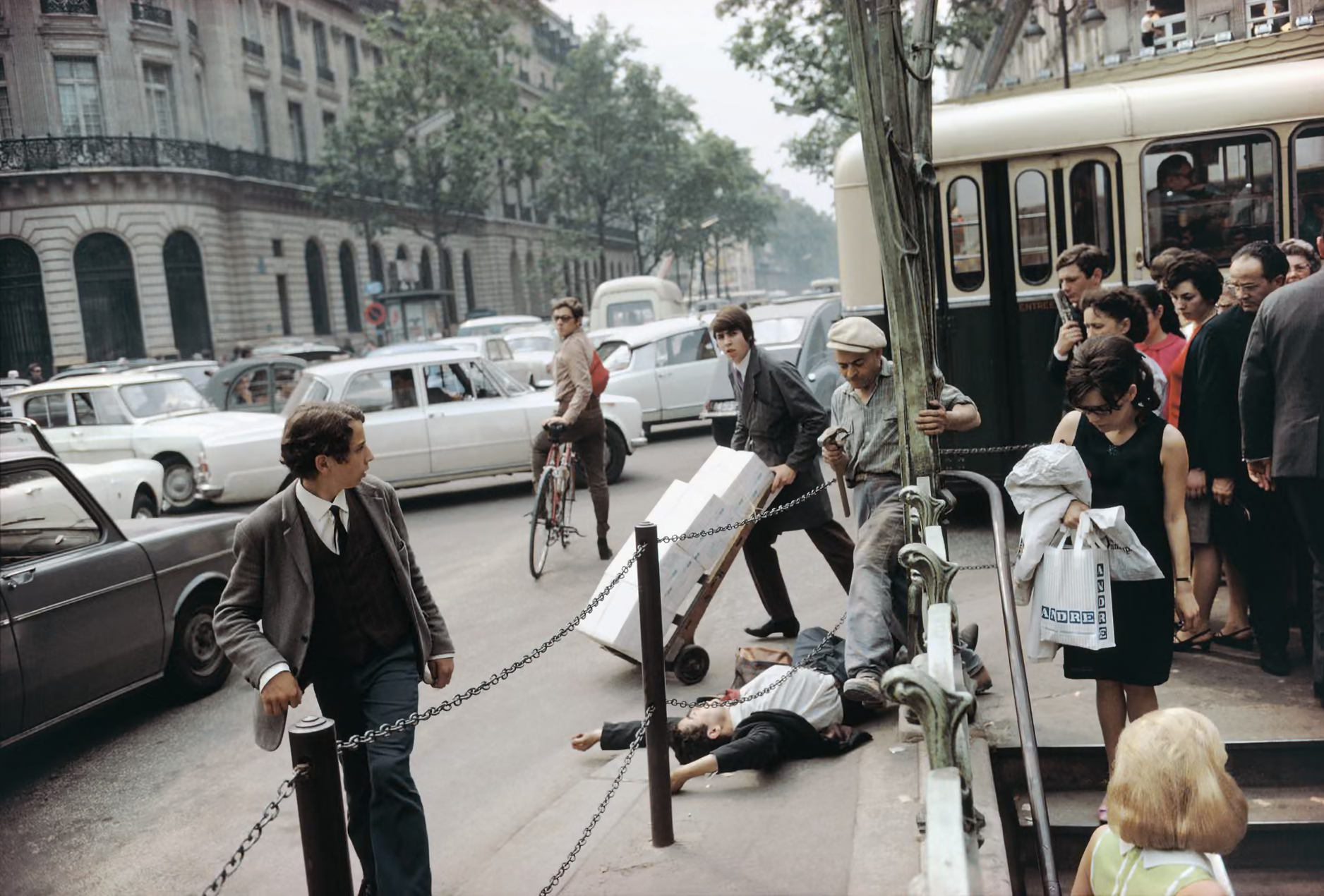
Copyright Joel Meyerowitz
I rarely get asked this question in such a direct way. People are generally afraid to or, even worse, assume it’s so obvious that they don’t need to ask. Well, I think people should ask. Not me, of course, but themselves. Just to make sure they haven’t wandered off the reservation.
If you want to know what I think (I assume you might as you’re here), then it’s a photo taken in a public place, ideally candid. It should be an interesting moment, alternatively something that looks nice. The so-called “fine art” street photo. I don’t really count portraits or protest photography. One could call them “street adjacent” if one was keen to. I think of them as documentary personally. Like I say, “my definition”, you do you.
OK, so that’s about it. To recap: interesting moment or interesting scene (an unusual character in a cafe maybe), pretty composition of something, doesn’t have to be thrilling, maybe a stride by, you’ve found a nice background and are waiting for a cool person to walk by, fair enough, good for you.
The thing that’s crucial though is I can define what I think is a Street Photo, but I think most people already know. They usually know instinctively, if they have done any research, what a “good” street photo is. They may have read some photo books, maybe even seen some “celebrity” Instagram Street Shooters’ grids. So why do I see so much bad street photography?
Problem 1: Our Fragile Egos
The trouble is that we all have a blind spot where our own work is concerned. I’m no exception, but I think, well, it’s at least a good start that I know this. Or at least give off the illusion I do!
One problem is that it’s hard these days to find good modern street photography to be inspired by. Books and zines are very expensive, sold in limited quantities, only available by web order. Chances are that you’ve seen all the photos in them on Instagram already.
And I personally prefer doing street than looking at it. Although I always have time for a good photo, just one can brighten my whole day.
Problem 2: Instagram!
I think the main issue amateur photographers face is Instagram and the need to be “seen to be visible”. As a former Instagram junkie, I would say there are better ways to do this than others.
I know of many street photographers who have successfully convinced apparently hundreds of thousands of “followers” (and real people too) that they are very good when the truth is that they are just good on Instagram.
Anyone who is half decent with a camera, lives in a cool city, has the time to put in some miles on the streets and knows their way around the sliders in Lightroom can, over five years, put together 20 or so nice images.
Instagram Street Influencer 101
On Instagram they post and repost these photos constantly, maybe with an occasional present-day photo that’s not very good but edited nicely and then will be deleted by the next day when it doesn’t cut the mustard with the algorithm. That’s probably the most efficient Instagram strategy if you’re interested.
I think it would be good if it cost money to post on Instagram, say £2.50 per photo. It goes up to a fiver if it doesn’t get enough likes. I think we would have a far different picture of the street photographers out there.
I think most people do know what’s good and what’s bad, but over-posting on Instagram I don’t think does them any favours.
The way I think of it is that sometimes you’re only as good as the last photo you showed me. If I see someone that posts a lot of average stuff and the occasional banger, then I think that person is an average photographer who is occasionally capable of taking a good photo.
Fair?
Better, I think, to post less frequently or do what some of the cynical “names” on Instagram do: play the hits, at least.
What if you really can’t tell?
For the people who are still reading who aren’t sure if their photos are good, it’s easy: compare them to your best. It’s usually a short exercise.
What about newbies?
If you haven’t built up a body of work yet and are only just starting, then ask someone experienced. Look at your photo and think: “Is this photo communicating to the viewer?”
Do they see the moment I saw? Is it obvious?
If going for Fine Art, look at the colour wheel, check your colours. Check your composition for good basics: rule of thirds, clear subject, figure to ground, symmetry etc etc.
Street photos are governed by the same rules as any other type of photography.
Problem 3: The Accessibility of Street Photography
The street is seen by everyone as being very accessible, and it is. Everyone who has a camera phone and can afford a bus fare can get to the street.
But getting to the street and being a Street Photographer are two different things.
There’s no special equipment required, no studio, no expensive lights, no permission needed. You can walk out of your front door and start doing it. That’s one of the things I love about it.
But that also means there’s very little stopping you from calling yourself a Street Photographer. The barrier to entry is basically nothing. The difficult bit comes afterwards.
Because the real truth is that time and talent are not accessible. You have to really put in the hours and of course some talent doesn’t hurt but as far as the street is concerned its70/30 graft vs talent in my opinion. If you are comfortable with all those things then being a good Street Photographer is accessible to You.
Have fun out there. It’s the same for everyone. It takes 100 street photos to maybe get a good one, so please don’t show the world your 99!
Meant in good faith, if you’re going to do something then try and be good and show the world your best side.
Rules for life.
